
 EN
EN
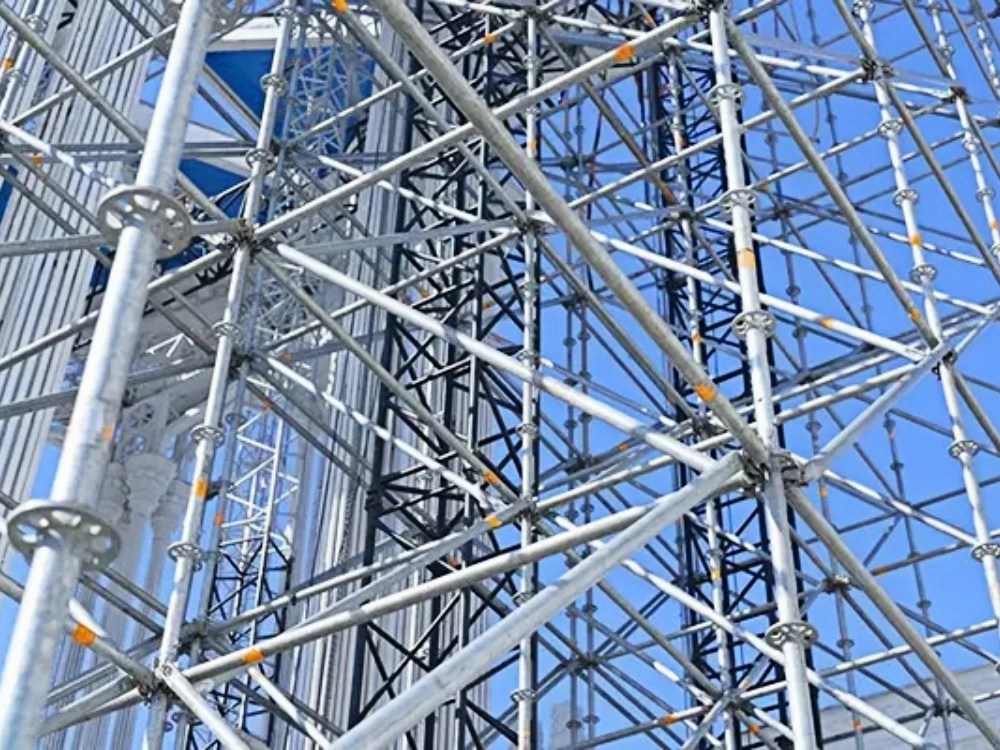
Ringlock Scaffold Design Flexibility for Non-Standard Architectures
360° rosette connector articulation enabling seamless curvature and multi-axis alignment
What makes Ringlock so versatile in architecture is its special 360 degree articulating rosette connector with eight evenly spaced connection points. Traditional systems are stuck at 90 degrees or fixed angles, but this new design lets workers adjust angles anywhere between 15 and 75 degrees. That means scaffolding can actually fit around tricky shapes like domes, spiral structures, curved building facades, and all sorts of unusual forms without losing strength when dealing with uneven forces or twisting pressures. The wedge lock system is another game changer. Just one hit with a hammer locks everything securely without needing extra tools. No more worrying about loose components falling off during work on complicated surfaces. According to a study published in Construction Innovation Journal last year, this setup cuts down installation time by almost half compared to old fashioned tube and clamp methods. Plus it keeps things rigid even when loads aren't distributed regularly.
Modular adaptability across freeform façades, cantilevers, and parametric geometries
Ringlock’s standardized yet highly configurable components deliver proven adaptability across three demanding architectural contexts:
- Freeform façades: Vertical standards spaced at 500mm intervals enable millimeter-precise alignment with undulating surfaces—such as those found in Zaha Hadid–inspired fluid architecture—through incremental ledger positioning and rosette reorientation
- Cantilever support: Optimized diagonal bracing configurations extend safe overhangs beyond conventional limits, exemplified by the 18-meter unsupported canopy at Singapore’s Jewel Changi Airport
- Parametric installations: Prefabricated node connectors integrate directly with BIM-coordinated designs, supporting fractal patterns, non-repeating arrays, and algorithmically generated forms
The system accommodates slope gradients up to 35° without custom fabrication—making it especially valuable for heritage renovations where existing structures defy modern symmetry. This reconfigurability reduces material waste by 28% on complex projects (Global Scaffolding Efficiency Report 2024), as components are reused across phases and geometries.
Structural Performance and Compliance in Asymmetric Ringlock Scaffold Configurations
EN 12811-1 Load Path Validation Under Torsional and Eccentric Loading
When dealing with asymmetric structures featuring curves, cantilevers, or angled bases, engineers face challenges from torsion and off-center loading that require thorough checking according to EN 12811-1 guidelines. For these complex setups, finite element analysis becomes almost indispensable for tracing how loads travel through the structure, spotting areas where stress builds up around connection points, and making sure bending doesn't go beyond what's acceptable - typically no more than 1/500th of the total span length. The materials need to handle at least 235 MPa pressure when subjected to maximum uneven forces. During testing phases, strain gauges are commonly installed to track actual deflections against theoretical predictions. Following these procedures helps maintain safety standards not only when everything stands still, but also when dealing with movement from things like gusty winds pushing against buildings or shifting weights inside storage facilities.
Diagonal Bracing Strategies and Stability Optimization: Lessons from High-Profile Complex Builds
Diagonal bracing is the primary lever for stability in asymmetric Ringlock setups. Field-proven strategies from landmark projects include:
- X-bracing density: Doubling bracing frequency at geometry transition zones—such as curve-to-straight interfaces—significantly increases buckling resistance
- Node reinforcement: Adding ledger beams at 90° angles to key rosettes improves eccentric load distribution and reduces joint rotation
- Foundation tuning: Adjustable base plates accommodate ground slopes up to 15°, ensuring vertical load transfer without shimming or custom footings
Staggered (rather than uniformly spaced) bracing intervals have been shown to suppress harmonic vibration in towers exceeding 50m—maintaining stability even under extreme 6 kN/m² wind loads.
Pre-Erection Engineering and Planning for Complex Ringlock Scaffold Projects
BIM-driven design coordination, 4D sequencing, and clash detection for precision deployment
When it comes to complex Ringlock scaffolding projects, Building Information Modeling (BIM) has completely changed how we approach the planning stage. With BIM, engineers can create virtual prototypes of those tricky non-standard geometries long before any actual components ever leave the manufacturing facility. The real game changer here is advanced 3D modeling that spots potential clashes between scaffold parts and other structural elements like steel reinforcements, cladding anchors, and those pesky MEP penetrations throughout the building. Industry studies show this proactive approach cuts down on rework by about 15 to 20 percent, which adds up to significant cost savings over time. Then there's four-dimensional sequencing, where time factors get layered into the model itself. This lets teams simulate how different sections will be assembled step by step around challenging features such as cantilevered structures or buildings with curved facades. What makes all this so valuable? Well, the digital rehearsal aspect means materials arrive exactly when needed, reduces last minute fixes on site, and becomes absolutely essential in cramped city locations or historic buildings where even small measurement errors (under 50mm) can spell disaster for preservation efforts.
Competent person oversight and engineered drawing requirements beyond standard system guidance
Standard Ringlock system guidance applies only to basic, symmetric configurations. Any deviation—including curved alignments, cantilevers >3m, slopes >5°, or point loads >24 kN—requires formal engineering validation and oversight by a certified Competent Person. Their responsibilities include:
- Conducting site-specific risk assessments for wind shear, ground instability, and adjacent structure interaction
- Designing custom bracing layouts to manage torsion and lateral drift
- Specifying non-standard foundation solutions, such as piled bases or reinforced sole plates
When scaffolding goes beyond what's considered basic according to NASC TG20:21 guidelines, specifically anything involving access bridges over eight meters long or structures that need to hold more than twenty four kilonewtons at any single point, then proper engineered drawings are required by law. The paperwork involved isn't just something to tick off a list either. According to recent stats from the Health and Safety Executive in their 2023 report, nearly two thirds of all scaffolding accidents happen because someone didn't plan things out properly. That's why getting experts involved before erecting anything complicated isn't optional—it's absolutely essential for safety reasons.
FAQ
What is Ringlock scaffolding?
Ringlock scaffolding is a modular system known for its versatile 360-degree articulating rosette connector, which allows adjustments at various angles. This system is used to construct scaffolding around non-standard architectural shapes.
How does the Ringlock system improve safety and efficiency?
Ringlock scaffolding enhances safety due to its secure wedge lock system, which reduces the risk of loose components. It also improves efficiency by cutting installation time in half compared to traditional methods.
What architectural contexts is Ringlock adaptable for?
Ringlock scaffolding is adaptable for freeform façades, cantilever supports, and parametric installations, making it ideal for complex architectural projects.
Why is engineering oversight crucial for complex Ringlock projects?
Engineering oversight ensures that scaffolding setups meet safety standards. It involves site-specific risk assessments, custom bracing design, and specifying non-standard foundation solutions to prevent accidents.